
Le choix du bon matériau est probablement l'une des décisions les plus importantes de tout projet d'usinage. Si vous vous trompez, même une programmation parfaite ne sauvera pas la pièce. S'il est bien fait, tout ce qui suit - temps d'usinage, état de surface, durabilité, coût - tend à se mettre en place plus facilement.
Ce guide couvre les cinq matériaux qui reviennent le plus souvent lors de la production de Pièces fraisées CNC. Chacune a sa propre personnalité sur la machine, ses propres forces et ses propres particularités. La compréhension de ces différences facilite les décisions relatives aux spécifications, les conversations avec les fournisseurs et les attentes réalistes quant à ce qui est réalisable.
Comparaison des matériaux pour les pièces fraisées CNC en un coup d'œil
| Matériau | Usinabilité | La force | Poids | Résistance à la corrosion | Coût relatif |
| Aluminium | Excellent | Modéré | Faible | Bon | Faible-Moyen |
| Acier | Modéré | Haut | Haut | Variable | Moyen |
| Acier inoxydable | Défi | Haut | Haut | Excellent | Moyenne-élevée |
| Laiton | Excellent | Modéré | Moyen | Bon | Moyen |
| Titane | Difficile | Très élevé | Faible | Excellent | Haut |
| Plastiques techniques | Excellent | Faible-modéré | Très faible | Excellent | Variable |
Ce tableau simplifie considérablement les choses - la sélection des alliages dans le monde réel implique bien plus de nuances - mais il constitue un point de départ utile pour la comparaison.
1. L'aluminium : Le choix par excellence pour les pièces fraisées CNC
S'il existe un matériau par défaut dans le monde du fraisage, c'est probablement l'aluminium. Dans presque tous les ateliers d'usinage, on trouve des copeaux d'aluminium sur le sol. Les raisons en sont assez simples.
Les machines en aluminium sont rapides. Vraiment très rapide par rapport à la plupart des autres matériaux. Les vitesses de broche peuvent être élevées, les vitesses d'avance peuvent être agressives et le matériau coopère. La durée de vie de l'outil reste raisonnable, les copeaux s'évacuent proprement et les finitions de surface sont belles sans effort héroïque.
Les alliages d'aluminium les plus couramment usinés sont les suivants :
- 6061-T6 - excellentes propriétés générales, bonne résistance à la corrosion, largement disponible
- 7075-T6 - plus résistant, courant dans les applications aérospatiales
- 2024-T3 - bonne résistance à la fatigue, utilisé dans les composants structurels
- 5052 - meilleur pour les opérations de formage mais s'usine encore de manière acceptable
Le poids compte aussi. Avec une densité inférieure d'environ un tiers à celle de l'acier, l'aluminium s'impose partout où la réduction de la masse est importante : aérospatiale, automobile, électronique grand public, drones.
2. L'acier : Quand la force ne peut être compromise
L'acier n'est pas aussi facile à usiner que l'aluminium. Il est plus dur pour l'outillage, génère plus de chaleur et nécessite des paramètres plus lents. Mais lorsque les pièces fraisées par CNC doivent supporter des charges importantes, l'acier reste souvent la seule solution pratique.
- Acier doux 1018 - facile à usiner, bon pour les pièces à usage général
- Acier allié 4140 - résistance plus élevée, traitement thermique, courant pour les composants mécaniques
- Acier de construction A36 - économique, utilisé pour les fixations et les pièces moins critiques
- Acier à moyenne teneur en carbone 1045 - équilibre entre résistance et usinabilité
Le compromis est toujours entre l'usinabilité et les propriétés finales. Les aciers plus tendres se coupent plus facilement mais ne peuvent pas être utilisés dans des applications exigeantes. Les nuances plus dures sont plus performantes en service, mais coûtent plus cher en termes de temps de cycle et d'usure des outils.
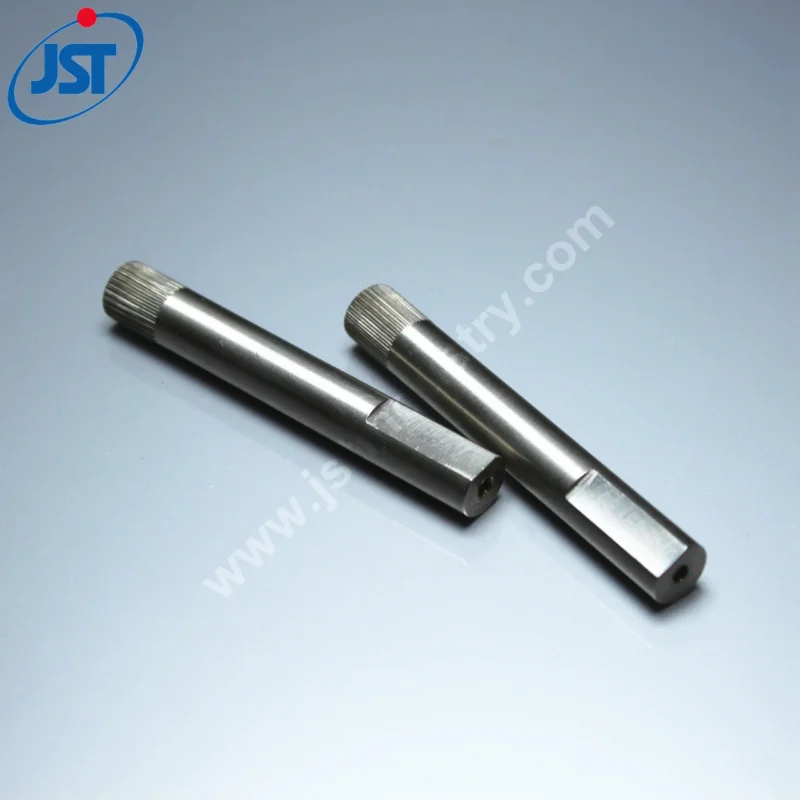
3. Acier inoxydable : La résistance à la corrosion et la durabilité
L'acier inoxydable occupe une catégorie à part car son comportement en matière d'usinage diffère sensiblement de celui des aciers au carbone. Il se durcit pendant la coupe, ce qui signifie que la surface devient plus dure au fur et à mesure que l'outil passe dessus. Cette caractéristique rend la sélection des paramètres plus délicate.
- 303 - qualité d'usinage libre, meilleur choix lorsque la résistance à la corrosion est importante mais que la facilité d'usinage est prioritaire.
- 304 - l'acier inoxydable le plus courant, plus difficile à usiner mais plus résistant à la corrosion
- 316 - résistance chimique supérieure, courante dans les environnements médicaux et marins
Les pièces fraisées CNC en acier inoxydable sont constamment utilisées dans les équipements de transformation des aliments, les appareils médicaux, les systèmes de manutention des produits chimiques et le matériel maritime. Le coût du matériau et les difficultés d'usinage en valent la peine lorsque l'application exige ce niveau de protection contre la corrosion.
4. Le laiton : Sous-estimé et exceptionnellement usinable
Le laiton ne fait pas l'objet de la même attention que l'aluminium, mais les machinistes ont tendance à apprécier de travailler avec lui. Le matériau se coupe très bien - copeaux propres, finitions lisses, usure minimale de l'outil. Il y a presque quelque chose de satisfaisant dans la façon dont il se comporte.
Les applications typiques des pièces fraisées CNC en laiton sont les suivantes :
- Connecteurs et bornes électriques
- Corps de vanne et raccords de plomberie
- Quincaillerie décorative et composants architecturaux
- Pièces pour instruments de musique
- Bagues et surfaces d'usure à faible frottement
Le laiton de décolletage C36000 est la nuance la plus utilisée. C'est essentiellement la référence par rapport à laquelle l'usinabilité des autres matériaux est mesurée. Cependant, la teneur en plomb qui permet un usinage aussi efficace a fait l'objet d'un examen réglementaire, ce qui a poussé certaines applications à utiliser des alternatives sans plomb.
5. Plastiques techniques : Légers et polyvalents
Le métal n'est pas indispensable à toutes les applications. Les plastiques techniques se sont taillé une place de choix dans les pièces fraisées à la CNC, en particulier lorsque le poids, l'isolation électrique ou la résistance aux produits chimiques sont plus importants que la résistance pure.
- Delrin (acétal) - dimensionnellement stable, faible frottement, excellent pour les engrenages et les bagues.
- PEEK - thermoplastique haute performance, résistant aux températures extrêmes, utilisé dans le domaine médical et aérospatial.
- Nylon - robuste et résistant à l'usure, idéal pour les composants mécaniques
- HDPE et UHMW - résistants aux produits chimiques, courants dans l'industrie alimentaire
- Polycarbonate - résistant aux chocs, options optiquement claires disponibles
Les plastiques s'usinent rapidement et n'exigent pas d'outillage, mais ils requièrent des approches différentes de celles des métaux. Le dégagement des copeaux est plus important et certains plastiques peuvent fondre si la vitesse de coupe génère trop de chaleur. Des outils bien affûtés et des avances correctes permettent d'éviter la plupart des problèmes.
Facteurs devant guider la sélection des matériaux
Le choix d'un matériau ne dépend pas uniquement de l'agrément des machines. Plusieurs facteurs méritent d'être pris en considération :
- Exigences mécaniques - solidité, dureté, résistance à la fatigue
- Exposition environnementale - températures extrêmes, produits chimiques, humidité
- Contraintes de poids - critiques dans l'aérospatiale, l'automobile, les appareils portables
- Sensibilité au coût - le coût du matériau plus le temps d'usinage est égal au coût total de la pièce
- Conformité réglementaire - RoHS, approbation de la FDA, normes spécifiques à l'industrie
- Finition de surface et exigences esthétiques
Parfois, la réponse est évidente. D'autres fois, elle implique des compromis qui nécessitent une réflexion approfondie. Une conversation avec un machiniste ou un ingénieur de fabrication expérimenté permet souvent de clarifier l'orientation la plus judicieuse. Si vous souhaitez en savoir plus sur les pièces usinées en CNC, lisez le document suivant Qu'est-ce que le fraisage CNC ? Le guide complet.
FAQ
Quel est le matériau le plus facile à usiner pour les pièces fraisées à la CNC ?
L'aluminium et le laiton sont toujours les métaux les plus faciles à usiner. Parmi les plastiques, le Delrin et le nylon s'usinent très bien. Le laiton C36000 sert en fait de référence en matière d'usinabilité - les autres matériaux sont souvent évalués en pourcentage par rapport à cette référence.
Le fraisage CNC peut-il traiter de l'acier trempé ?
Le fraisage CNC standard fonctionne mieux sur les matériaux dont la dureté est inférieure à environ 45 HRC. Les aciers entièrement trempés au-dessus de ce seuil nécessitent généralement un outillage spécialisé, des paramètres plus lents ou des processus alternatifs tels que l'usinage par décharge électrique. Certains ateliers fraisent les matériaux trempés, mais cette opération est plus exigeante et plus coûteuse.
Comment le choix des matériaux influe-t-il sur le coût des pièces fraisées à la CNC ?
Le matériau influe sur le coût de deux manières : le prix de la matière première et le temps d'usinage. Le titane coûte plus cher à l'achat et prend plus de temps à découper, ce qui le rend onéreux sur les deux fronts. L'aluminium est abordable et s'usine rapidement, ce qui permet de réduire les coûts. La matière première la moins chère n'est pas toujours la pièce finie la moins chère si elle est difficile à usiner.
 FR
FR  EN
EN  DE
DE  RU
RU  ES
ES  IT
IT  AR
AR  JA
JA