
There’s a good chance that many of the products people interact with daily — phone housings, car engine parts, even medical implants — were shaped through CNC milling at some point during production. It’s one of those manufacturing processes that quietly sits behind an enormous range of industries without most people ever thinking about it.
This guide breaks down the fundamentals. What the process actually involves, what types of machines exist, which materials work best, and where the technology gets applied most. Whether approaching the subject for the first time or brushing up on the basics, the essentials are all here.
How CNC Milling Actually Works
At its core, CNC milling is a subtractive manufacturing process. A rotating cutting tool removes material from a solid workpiece to create the desired shape. What sets it apart from manual milling is the computer numerical control aspect — every movement of the cutting tool follows pre-programmed instructions, typically generated from a CAD model.
The workpiece sits on a table or fixture. The spindle holds and rotates the cutting tool. And the machine moves along multiple axes to carve out geometry that would be difficult or impossible to achieve by hand. It sounds straightforward, and conceptually it is. But the precision involved is remarkable — we’re talking tolerances measured in hundredths of a millimeter.
The Basic Process Flow
- A 3D model gets designed in CAD software
- CAM software converts the design into machine-readable G-code
- The operator sets up the workpiece, selects appropriate tooling, and loads the program
- The CNC milling machine executes the programmed toolpaths automatically
- After machining, parts go through deburring, inspection, and any secondary finishing
The whole cycle can take minutes for simple parts or hours for complex components with tight tolerances. Speed depends on material, geometry, and how much material needs removing.
Types of CNC Milling Machines
| Machine Type | Number of Axes | Capabilities | Typical Use Cases |
|---|---|---|---|
| 3-Axis Mill | 3 (X, Y, Z) | Basic contouring, pocketing, drilling | Flat parts, simple 3D surfaces |
| 4-Axis Mill | 4 (adds A-axis rotation) | Angled features without repositioning | Engraving, arc cuts, cylindrical work |
| 5-Axis Mill | 5 (adds A and B rotation) | Complex freeform surfaces in single setup | Aerospace, medical, turbine blades |
| Vertical Mill | 3-5 | Spindle oriented vertically | General purpose, most common type |
| Horizontal Mill | 3-5 | Spindle oriented horizontally, better chip evacuation | Heavy cuts, high-volume production |
Five-axis machines are where things get interesting — and expensive. They allow the tool or workpiece to rotate on two additional axes, meaning incredibly complex shapes can be machined in a single setup. Less repositioning means better accuracy and faster throughput, though the programming complexity goes up significantly.
Materials Commonly Used in CNC Milling
One of the great things about CNC milling is its versatility with materials. Pretty much any solid material can be milled, though some cooperate more willingly than others.
Metals
- Aluminum — fast to machine, lightweight, excellent for prototyping and production alike
- Steel and stainless steel — harder on tooling but necessary for structural applications
- Brass — machines beautifully with clean finishes
- Titanium — challenging but essential for aerospace and medical
Non-Metals
Engineering plastics like PEEK, Delrin, and nylon are common, as are composites including carbon fiber reinforced materials, and softer mediums like wood and foam for models and prototypes.
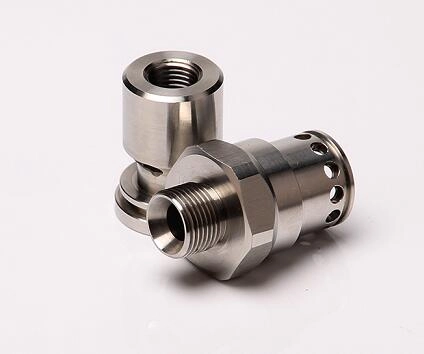
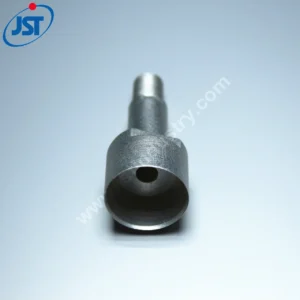
In the realm of metals, aluminum probably sees more CNC milling spindle time than any other material. It cuts quickly, doesn’t punish tooling, and suits an enormous range of applications. For components requiring greater strength and durability, CNC Turning Milling Steel Parts represent a fundamental category, balancing machinability with structural integrity for countless industrial uses. Titanium sits at the opposite end of the spectrum — slow feeds, specialized tooling, and expensive, but indispensable for certain high-performance industries.
Where CNC Milling Gets Applied
The applications are genuinely broad. Some of the heaviest users include:
- Aerospace — structural brackets, turbine components, landing gear parts
- Automotive — engine blocks, transmission housings, custom fixtures
- Medical — surgical instruments, implant components, prosthetic devices
- Electronics — enclosures, heat sinks, connector housings
- Tooling and molds — injection mold cavities, die components, jigs
Almost any industry that needs precision metal or plastic parts relies on CNC milling to some extent. Even the food processing and energy sectors use milled components in their equipment. It’s that pervasive.
Advantages and Limitations Worth Noting
What Makes It Attractive
The precision is hard to beat. Repeatability across thousands of parts, complex geometry capability, and compatibility with a wide material range — all strong reasons the process dominates manufacturing floors worldwide.
Where It Has Constraints
Material waste is inherent since it’s subtractive. Internal geometries with deep cavities or undercuts can be problematic. And setup costs for low-volume runs can feel steep compared to something like 3D printing, though per-part costs drop significantly at scale.
FAQ
What is the difference between CNC milling and CNC turning?
CNC milling uses a rotating cutting tool against a stationary or slowly repositioned workpiece. CNC turning rotates the workpiece itself against a stationary tool. Milling excels at flat surfaces, pockets, and complex 3D shapes, while turning is best for cylindrical or round parts like shafts and bushings.
How accurate is CNC milling?
Standard CNC milling holds tolerances around ±0.025mm without special effort. High-precision setups can achieve ±0.005mm or better, especially on five-axis machines with proper tooling and environmental controls. Accuracy depends on machine condition, material, and operator skill.
Is CNC milling expensive for small production runs?
Setup costs — programming, fixturing, tool selection — get spread across however many parts are produced. For very small quantities, the per-part cost is higher compared to large runs. That said, CNC milling remains more cost-effective than many alternatives for precision parts even at low volumes, especially when tight tolerances are required.
 EN
EN  DE
DE  FR
FR  RU
RU  ES
ES  IT
IT  AR
AR  JA
JA